

It’s harder than ever for teens to make friends in the digital age. Having strong friendships in adolescence is associated with better mental and emotional health as adults, but between the constant pressures of social media and the normal growing pains of being a teenager, your teen might feel isolated, lonely, and unsure what to do about it. If you’re wondering how to help your teenager make friends, here’s what you should know.
Kids are lonelier today than ever. Compared to those over 70, people aged between 16–29 are twice as likely to say they feel lonely “often or always.” What’s more, over 30% of young people say they don’t know how to make new friends.
Loneliness isn’t just a fleeting feeling — it can increase the risk of depression and anxiety among adolescents. That’s a problem, considering we’re already in the midst of a youth mental health crisis.
Positive relationships can help improve everything from school attendance to your child’s likelihood of graduating college. But the way teens make friends has changed over time. The rate of teens meeting up with their friends “almost every day” has decreased from 50% in the ‘90s to 25% today.
What changed? Although the percentage of teens meeting up with friends has been declining over the last few decades, there’s a steep dropoff in 2010 — when smartphones went mainstream. Text messages, social media, and Snapstreaks became the digital currency of social clout. It became easier for teens to feel connected online, even though offline friendships are more meaningful and intimate.
Being a teenager is radically different today than it was a few short years ago. That means making friends and maintaining strong friendships is radically different, too.
If you want to know how to help your teenager make friends, the biggest step is encouraging your teen to try new things. It’s hard to meet new people without going into new spaces, so you’ll want to work with them to discuss their interests and brainstorm ways they can use those interests to spark new connections. Here are some places to start:
You might feel super motivated to help your teen make friends, but keep in mind that you don’t always know the finer social dynamics of their world. Your teen might not even realize that they feel lonely. They might even feel overwhelmed if you throw a bunch of ideas at them at once.
Instead, get them talking. Here are some ways to spark a dialogue:
Be open, not judgmental. If you’ve noticed that your teen is spending more time alone than normal, ask them about it in a non-confrontational way, like, “I noticed you’re not hanging out with Sammy as often. Is everything okay?”
Show interest in their interests. Teens can easily pursue their passions and find niche communities online, but you wouldn’t know it unless you get involved. If your child mentions something they enjoy, ask them what they like about it. It might lend itself to an in-person activity. For example, if they’re really into a certain series, you might suggest inviting a friend and hosting a movie night.
Validate their feelings. If your teen says they feel like they don’t have any friends, you might be tempted to give them a million and one solutions to the problem. Instead, give them space to talk about their experiences. Questions like “That’s rough. Can you tell me more about how you feel?” or “What makes you think that?” can encourage your child to keep talking and give you space to examine what might be holding them back from making friends.
It can be difficult for parents to recognize when their teens are struggling, especially if they tend to isolate themselves behind screens. Monitoring your child’s online activity can help identify any red flags, like signs of depression or conflicts that might hinder their ability to make friends.
BrightCanary monitors what your child types across their text messages, social media, Google, YouTube activity, and more. The app uses the American Psychological Association’s emotional communication guidelines to categorize conversations, so you can identify anything concerning at a glance.
Plus, our AI-generated summaries make it easy to understand online messages, identify any potential issues early on, and have more informed check-ins with your child.
Look for signs of withdrawal, increased screen time, or reluctance to engage in social activities. Ask your child how they spend their free time—do they check in with friends during passing periods and participate in after-school activities, or do they spend most of their time alone?
Encourage open communication, help them explore new social groups, and monitor for any signs of bullying or depression. Recognize that you may not be able to solve their unique social dynamics, but you can give them space to work through their feelings and find different spaces for connection.
Yes, it's becoming more common, but it's important to ensure these online friendships are healthy and positive.
Focus on quality over quantity. Encourage them to pursue hobbies or activities where they can meet people with similar interests in smaller, more comfortable settings. Introverted teens may not want to attend large sporting events, but they may be interested in a book club or cooking class.
It's important to find a balance—be supportive and present, but allow them the independence to navigate social situations on their own. Remember that their social life includes the digital world, and you’ll want to find a way to stay involved that works for your family. We recommend starting with regular online safety check-ins.
While making friends can be challenging, it’s a crucial part of teenage development. As a parent, you can help your teen brainstorm different ways to expand their social circle online and offline based on their interests. Sometimes, the most important thing you can do is give them space to talk and find solutions on their own (with your encouragement and guidance, of course).

What can tech companies do to keep kids safe online? The Biden-Harris Administration’s Kids Online Health and Safety Task Force recently released a comprehensive report with key recommendations for kids to have safer experiences online and on social media. With input from youth advocates, civil society organizations, and academic researchers, the report lays out what parents, caregivers, and the tech industry can do to address the ongoing youth mental health crisis. Let’s discuss the report’s recommendations for Big Tech and what that means for parents today.
The Kids Online Health and Safety Task Force was established in 2023 as part of the Biden-Harris Administration’s broader effort to address the ongoing youth mental health crisis. While social media and technology haven’t caused the crisis, evidence suggests that the increasing prevalence of digital technology in children’s lives has exacerbated the issue — to the point that the U.S. Surgeon General has called for warning labels on social media, much like the ones you see on tobacco and alcohol products.
Co-led by the Substance Abuse and Mental Health Services Administration (SAMHSA) and the National Telecommunications and Information Administration (NTIA), the Task Force aims to advance the health, safety, and privacy of minors online.
The report, titled “Online Health and Safety for Children and Youth: Best Practices for Families and Guidance for Industry,” is a detailed analysis of both the risks and benefits that social media and digital platforms pose to our kids.
While digital technology can enhance education and social connection, it also exposes young users to serious dangers, including cyberbullying, misinformation, and exploitation. The report stresses the need for protective measures that safeguard kids’ mental and physical well-being. Some of those measures will require broader regulation at the federal level, like what we see happening with the Kids Online Safety Act. Other measures can (and should) be implemented sooner rather than later.
The report outlines 10 key recommendations for Big Tech companies to foster safer online environments for kids — here’s a high-level overview:
We hear a lot about the need for parents to protect their children online. While it’s true that parents can and should use monitoring tools and child safety apps to guide, protect, and support their kids online, it does parents a disservice to place the burden of accountability solely on them. A lot of parental control settings are difficult to find on devices and apps. It’s common sense that children should have the highest privacy settings enabled by default. And major tech companies have shown time and time again that they aren’t capable of putting children’s best interests ahead of their bottom line.
By designing platforms with youth in mind, companies can protect children from the adverse effects of social media, such as exposure to harmful content and addictive features. These changes can also promote a healthier digital environment where children can benefit from technology without falling victim to features that compromise their well-being. But in order to make these changes happen, tech companies must move forward with these recommendations.
While the tech industry plays a crucial role, parents also have a part in ensuring their children’s online safety today. Parents should:
Kids deserve a safer digital environment, but they’re growing up in a digital world that wasn’t designed with their best interests in mind. Tech companies should take a stronger stance on child online safety, but these changes take time — which is why it’s important for parents to stay informed and involved today.
Be the most informed parent in the room. Subscribe to our biweekly newsletter Parent Pixels.
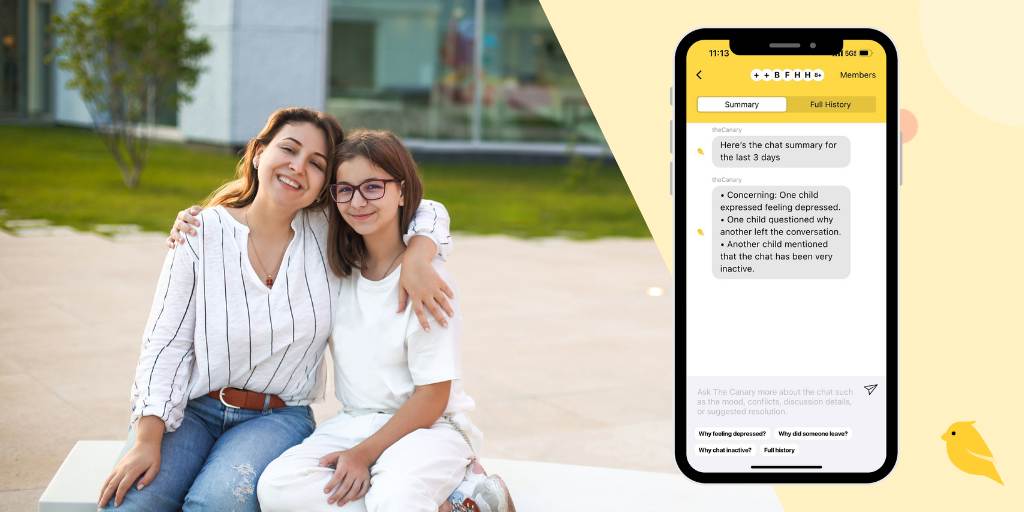
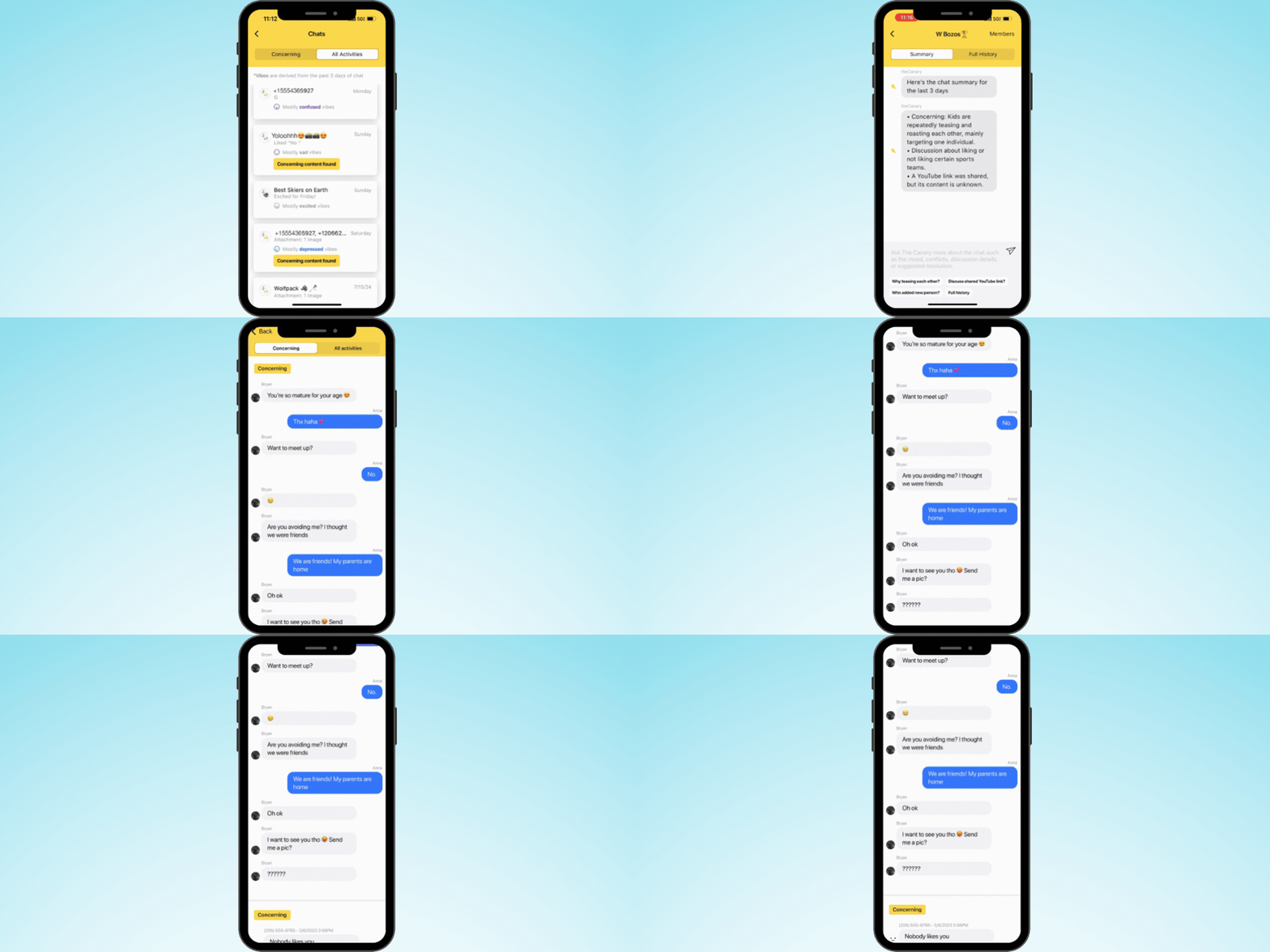
Monitoring your child’s text messages can help you ensure their safety and well-being. But when your child receives thousands of texts per week, the practicality of reading their messages becomes overwhelming. What if you miss something important, like references to bullying, drugs, or self-harm? Good news: We’re parenting in the digital age, and there are tools available that can make text monitoring easier and more effective.
BrightCanary’s new AI-powered text message summary feature helps parents stay informed, without having to read every individual message. The app’s advanced technology not only summarizes text threads, but it also provides insights into your child’s emotional well-being and tips on how to have meaningful conversations. We sat down with BrightCanary CTO and co-founder Steve Dossick to talk about the new feature and how it sets BrightCanary apart from other child safety tools.
Rebecca Paredes: Can you explain how BrightCanary’s new text message summary feature works?
Steve Dossick: Our goal is to help parents stay informed about their children’s lives and alert them when there’s a concern. To do that, we first anonymize each conversation thread and ask AI to do a couple of things:
We use the latest Large Language Model (LLM) AIs and supply them with extensive parenting guidelines to tailor answers for parental support. So, we created a parenting-focused AI, and then asked it to help parents.
RP: How accurate is this feature in measuring emotions and summarizing texts?
SD: No computer system is perfect, but we were truly astonished at how accurately the latest LLMs are able to summarize content and interpret human emotions. It seems strange to ask a machine to report on human emotions, but these AI systems are incredibly capable of understanding and summarizing text written by humans.
RP: How does the AI handle potentially sensitive or alarming content in text messages?
SD: The AI is trained with vast amounts of internet content. It is able to recognize patterns in text messages and identify sensitive or alarming content. We also tell the AI the child’s age range, which helps maintain accuracy.
RP: How do parents feel about text message monitoring?
SD: Parents want to know that their kids are staying safe, especially in their first journeys online. We want to provide guardrails so they’re ready for all the positives and negatives the internet can throw at them as they grow older and more independent. At the same time, privacy remains important, particularly for older children and teens.
After launching our text message monitoring feature, we quickly decided that we wanted to use the power of AI to summarize text threads — so they don’t need to take the time to read every last message while maintaining a level of privacy.
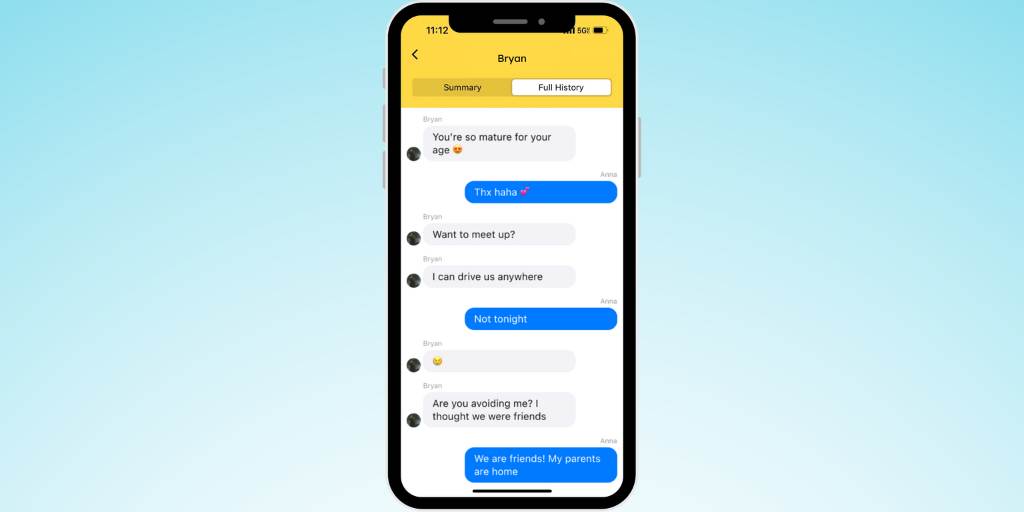
Of course, if something truly concerning is going on with a child, parents can still read the full thread. Additionally, our Ask the Canary AI offers guidance on addressing specific issues, like handling bullying at school.
RP: How do you see this feature evolving in the future? Are there any additional functionalities you plan to add?
SD: We’ve deployed this feature for text message monitoring, but we plan to use it across all of our child monitoring features (YouTube, Google, Instagram, TikTok).
RP: What makes this feature different compared to other text monitoring tools available?
SD: Most existing text and image monitoring tools were designed for user-generated content sites like Yelp or TripAdvisor. These sites are concerned that people are sharing reviews with profanity or concerning references. However, children’s text message conversations are drastically different from what other monitoring tools have been trained for.
Kids send one-word replies, abbreviations (mb, wyd), and misspellings. Traditional content moderation models struggle with this. LMs, on the other hand, are able to use the context to generate real insights into meaning and emotional content, making them better suited for child safety.
Ready to get started with text message monitoring? BrightCanary offers the most comprehensive child safety app for Apple devices. Start your free trial today, or learn more about how to monitor your child’s texts on iPhone.

Welcome to Parent Pixels, a parenting newsletter filled with practical advice, news, and resources to support you and your kids in the digital age. This week:
Tech giants have some ‘splaining to do. First up: Google and Meta allegedly made a secret deal to target advertisements for Instagram to teens on YouTube, according to the Financial Times. The project, which began in early 2023, exploited a loophole to bypass Google’s own rules prohibiting ad targeting to users under 18.
The advertising agency Spark Foundry, working for Meta's marketing data science team, was tasked with attracting more Gen Z users to Instagram, which has been losing ground to rival apps like TikTok. Evidence suggests that Google and Spark Foundry took steps to disguise the campaign’s true intent, bypassing Google’s policy by targeting a group called “unknown”—which just so happened to skew toward users under 18.
Jeff Chester, executive director of the Center for Digital Democracy, which advocates for child privacy, said, “It shows you how both companies remain untrustworthy, duplicitous, powerful platforms that require stringent regulation and oversight.”
Speaking of oversight … the Justice Department is suing TikTok and parent company ByteDance for violating children’s privacy laws. According to a press release, ByteDance and its affiliates violated the Children’s Online Privacy Protection Act (COPPA), which prohibits website operators from knowingly collecting, using, or disclosing personal information from children under the age of 13 without parental consent.
The complaint alleges that from 2019 to the present, TikTok:
These allegations come amid ongoing legal battles over a TikTok ban in the U.S. To add to the controversy, the Justice Department recently accused TikTok of gathering sensitive data about U.S. users, including views on abortion and gun control. The Justice Department warned of the potential for “covert content manipulation” by the Chinese government, suggesting that the algorithm could be designed to influence the content that users receive.
That’s a lot to take in: Indeed. We often talk to parents about the balance between trust and monitoring. We can trust our kids, but we can’t always trust Big Tech companies to protect them or prioritize their well-being.
Taking an active role in your child’s digital life is about more than just supervising their online activity — it also involves considering how these companies use children's data and how they might influence what your child consumes.
If your child uses social media or YouTube, it's a good idea to periodically check their feeds together. A child safety app like BrightCanary can help make this easier, but nothing beats having open conversations with your child about what they share and what they see.
Parent Pixels is a biweekly newsletter filled with practical advice, news, and resources to support you and your kids in the digital age. Want this newsletter delivered to your inbox a day early? Subscribe here.
Unfortunately, the popularity of parental control apps has attracted scammers that want to swindle and frustrate people. Here’s how to identify and avoid parental control scams on iPhone and Android, plus tips to select a reputable app that does what it claims.
Did you know that your kid could be using private browsing to hide their online activity from you? Despite this workaround, parents still have options for monitoring their child online. Here’s what you should know and how to talk to your kid about incognito mode.
Tech giants don’t have our children’s best interests at heart. Privacy is important, but so is staying informed and keeping our kids safe — parents need to understand what their children are consuming, both in their algorithms and through ads. If you’re worried about the privacy conversation, here are some conversation starters:
🤖 Roblox recently released new resources to educate users about generative AI (think: ChatGPT, DALL-E, and Roblox’s own GenAI). Here’s the guide for families and one made for teens.
👑 Meghan Markle and Prince Harry have entered the child safety chat: The Parents’ Network, a new initiative from the Duke and Duchess of Sussex, is intended to assist families of children lost due to social media harm.
👻 Snapchat rolled our new safety features, including expanded in-app warnings, enhanced friending protections, and simplified location sharing. (We’re still not fans of Snapchat for younger kids, but if your teen uses Snap, it’s worth checking out the app’s parental controls.)
😔 Watching just eight minutes of TikTok focused on dieting, weight loss, and exercise content can harm body image in young women, according to a new study.

Welcome to Parent Pixels, a parenting newsletter filled with practical advice, news, and resources to support you and your kids in the digital age. This week:
Guess who’s back, back again? After facing an uncertain path in the Senate, the Kids Online Safety Act (KOSA) successfully passed the Senate last Thursday. The historic vote was overwhelmingly bipartisan (86 to 1 to take up the measure), but things will be less rosy in the House, where KOSA faces hurdles in the form of free speech concerns and Big Tech lobbyists.
KOSA would introduce the most sweeping child online safety reform since the now-archaic Children's Online Privacy Protection Act (COPPA) was passed in 1998. As a recap, KOSA would:
While other child safety bills are also under consideration, KOSA is the closest to becoming law, although we won’t hear anything about its status until the House returns in September. Concerns about KOSA include stifling First Amendment-protected speech and isolating vulnerable youth from accessing information on social media.
At the same time, a growing body of experts are calling for stricter regulations on social media platforms for the sake of children’s mental health.
US Surgeon General Vivek Murthy said that social media should have a warning label, similar to the one required on tobacco products. A new report by the Biden-Harris Administration’s Kids Online Health and Safety Task Force urges the industry to make design choices that prioritize kids’ well-being, such as making privacy protections for youth the default and use data-driven methods to detect and prevent online harassment.
The kids are not alright, and child online safety legislation is overdue. If KOSA doesn’t pass, other options on the table include Sammy’s Law, which would require social media companies to integrate with child safety software, making it easier for parents to supervise their children’s online activities.
“Finalizing these safety bills has been a long and winding and difficult road, but one thing I’ve known from the start: It sure would be worth it,” Senator Chuck Schumer, Democrat of New York and the majority leader, said in a floor speech before the vote. “The message from these parents has been simple and consistent: It’s been long enough.”
Parent Pixels is a biweekly newsletter filled with practical advice, news, and resources to support you and your kids in the digital age. Want this newsletter delivered to your inbox a day early? Subscribe here.
What can parents do to make sure their teens aren’t texting personal information to strangers? Show this list of tips to your kiddo, or use it as a springboard for a conversation about texting safety.
VPNs are a popular way for kids to get around some parental control settings. Read on to learn about VPNs, how to know if your child is using one, and what you can do about it. (Psst: VPNs don’t impact BrightCanary monitoring.)
It’s important to give kids a degree of privacy, but it’s also important to guide, protect, and support them online and offline. Plus, it makes sense to be more hands-on when your kid first gets a phone or tablet, then give them more autonomy and independence as they grow older and more mature. All that to say, how do you talk to your child about privacy — especially when you start to introduce parental monitoring? Use these conversation-starters.
😫 How do you lay down ground rules about devices? What about tips to handle cyberbullying and online abuse? Teaching children to navigate the online world is a key part of modern parenting. In this Q&A, experts pass on tips to make it feel less overwhelming.
🔎 Meta has, historically, not been the most forthcoming with allowing researchers to review its data. But now, “after years of contentious relationships with academic researchers, Meta is opening a small pilot program that would allow a handful of them to access Instagram data for up to about six months in order to study the app’s effect on the well-being of teens and young adults.”
👉 We mentioned the Kids Online Safety and Health Task Force’s new report earlier in this newsletter, but we recommend taking some time to check it out — it’s packed with advice and conversation-starters for parents and caregivers, plus free resources for parents of tweens and teens.

Welcome to Parent Pixels, a parenting newsletter filled with practical advice, news, and resources to support you and your kids in the digital age. This week:
It’s a familiar scene of modern parenting: your child is upset, you’re already stressed, and you need just two minutes of peace — so you hand them a phone or tablet as a distraction. While this might provide a quick fix, new research suggests it could lead to long-term issues with their ability to control their emotions.
A new study found that when parents frequently use digital devices to calm their children, it can result in more severe issues with emotional regulation down the line. This creates a vicious cycle: parents with kids who have difficulty managing anger are more likely to use digital devices to cope with their children's emotional outbursts. The child learns to rely on their digital device, instead of learning how to soothe themselves on their own.
“Tantrums cannot be cured by digital devices,” said Dr. Veronika Konok, the study’s first author and a researcher at Eötvös Loránd University. “Children have to learn how to manage their negative emotions for themselves. They need the help of their parents during this learning process, not the help of a digital device.”
We get it: sometimes, you need a time-out. But this research highlights the importance of fostering healthier digital habits and emotional skills in kids, instead of always relying on an iPad.
This study focused on younger children, but what’s interesting is that a similar trend exists among teens. A recent Rutgers University-New Brunswick study found that teens are intentionally creating roadblocks in their social media use to remind them to take a break or stop scrolling altogether.
For example, older teens reported using reminder apps and calendar notifications to resist the temptation to scroll social media for hours, especially when they’re feeling bored or have nothing else to do. Older kids are aware that social media apps are designed to keep them hooked for hours, but younger children may not have this same level of self-awareness.
Some takeaways:
🤝 Parents should coach their children through difficult situations, help them recognize their emotions, and teach them how to handle them. When kids are bored, suggest screen-free activities before they reach for their devices.
😌 Children learn from observing their parents, so parents need to show their kids how to manage stress without immediately turning to screens.
📵 If children are having a hard time managing their screen time, that’s a sign that they’re emotionally dependent on media in an unhealthy way. Set screen time limits and plan on ways to help your child transition away from devices when their screen time is up.
Parent Pixels is a biweekly newsletter filled with practical advice, news, and resources to support you and your kids in the digital age. Want this newsletter delivered to your inbox a day early? Subscribe here.
We know that setting healthy screen limits is in our children’s best interest. But the pushback we face when we try to set or enforce those limits can weaken the resolve of even the most determined among us. Here’s how to handle screen time tantrums.
Parental control apps can help keep your child safe, but only if they work. These popular apps are really easy for your child to delete and defeat. Find out where they fail and what we recommend instead.
Ah, screen time tantrums. When screen time is over, does your child roll their eyes at you, or do they flail on the ground like a fish out of water? Here are some ways to talk to your child about the way they feel with screens.
🦺 Just as “it takes a village to raise a child,” safeguarding children online requires a collective effort from parents, governments, law enforcement, and tech executives. Read more from John Tanagho, Executive Director of International Justice Mission’s Center to End Online Sexual Exploitation of Children, via Fast Company.
📱 All Virginia public schools are going phone-free as of January 1, 2025. What are your thoughts about phone-free schools?
🐤 Did you know? BrightCanary text message monitoring now summarizes your child’s text threads and highlights concerning content. Take a look at the latest version of the app and let us know what you think.

Welcome to Parent Pixels, a parenting newsletter filled with practical advice, news, and resources to support you and your kids in the digital age. This week:
If it seems like your child is glued to their screens 24/7, they might be learning from you. New research published in Pediatric Research found that parental screen use is highly associated with higher adolescent screen time and problematic social media or video game use.
This is tied to “parental modeling,” where kids learn behaviors from their parents. If they see you watching screens during meals or using your phone in bed, they don’t learn to set boundaries around device use. This is problematic because screen use during meals and at bedtime is linked to higher overall screen time and addictive behaviors, like struggling to reduce social media use and dropping everything to respond to a notification on their phone.
“It’s especially important that parents follow their own rules and practice what they preach,” said Jason Nagata, a pediatrician at the University of California at San Francisco and the lead author of the study, “because even if they think their kids aren’t watching them, they really are.”
What parents can do: First, recognize that screens aren’t inherently bad — but kids need to learn healthy device use. Here are some recommendations:
🛑 Set screen time limits and stick to them. The study found that parental monitoring and limiting adolescent screen time were linked to less problematic screen use. Tools like Apple Screen Time, Google Family Link, and apps like Unpluq can help.
🍽️ Enforce screen-free zones at home. Start with no phones at the dinner table and no phones in the bedroom at night. Explain why these changes matter, such as improving sleep by avoiding blue light.
💬 Talk about device use. If you struggle to avoid certain apps, be honest with your child. This can spark a conversation, as they might be dealing with similar issues, allowing you to brainstorm solutions together.
Parent Pixels is a biweekly newsletter filled with practical advice, news, and resources to support you and your kids in the digital age. Want this newsletter delivered to your inbox a day early? Subscribe here.
What is Apple Screen Time work, and how can parents use it to set limits on their kids’ devices? We break down essential tips for this free resource that every parent should know.
Looking for new ideas for spending time with family this sumer? We’ve got you covered with eight ideas for quality time.
One way to get your child’s buy-in when you’re introducing the whole “use your phone less” topic? Get them talking. Save these conversation-starters for your next check-in.
📵 The largest US school district has banned phones in schools. The Los Angeles Unified School District will ban cellphones during the entire school day, possibly by having students place their phones in lockers or pouches. The ban takes effect in January.
❗An exclusive WSJ report found that Instagram recommends sexual videos to accounts for 13-year-olds. The findings align with a 2022 Meta analysis that found teens saw three times as many prohibited posts containing nudity, 1.7 times as much violence and 4.1 times as much bullying content as users above the age of 30. According to Meta, teens under 16 aren’t supposed to be shown sexually explicit content at all — more reason to not trust social media companies to protect our kids.
👀 Word on the street is that there’s a new look with BrightCanary text monitoring. Have you tried our new text message summaries with built-in advice and coaching? Download the latest version of BrightCanary today!
😌How do you cultivate mindful digital habits at home? We spoke with Unpluq CEO Caroline Cadwell about how parents can model appropriate digital behavior for kids.

Welcome to Parent Pixels, a parenting newsletter filled with practical advice, news, and resources to support you and your kids in the digital age. This week:
What if the next time your child signs up for a social media platform, they’re faced with a health warning — the same kind of label you see on cigarettes?
Surgeon General Dr. Vivek Murthy recently called for a warning label that states social media is associated with significant mental health harms for adolescents. The statement comes after Murthy issued a health advisory in May 2023, warning that social media is contributing to the youth mental health crisis.
What is a warning label? You’ve likely seen these labels on tobacco and alcohol products. A surgeon general’s warning label is a public statement that calls attention to a critical public health issue.
Warning labels can’t be implemented without congressional approval, but Murthy’s statement furthers a growing movement for regulation on social media to help keep kids safe and minimize the dangers of addictive design features. For example, New York recently passed a measure that bans social media platforms from algorithmically recommending content to children.
It’s not over: Murthy acknowledges that a warning label, on its own, wouldn’t make social media safer for young people. He also urges legislators to:
“There is no seatbelt for parents to click, no helmet to snap in place, no assurance that trusted experts have investigated and ensured that these platforms are safe for our kids,” he wrote. “There are just parents and their children, trying to figure it out on their own, pitted against some of the best product engineers and most well-resourced companies in the world.”
Parents can help, too — by creating more phone-free experiences at home and at school, supervising kids’ social media use, and delaying giving kids access to phones until after middle school. Stay involved, ask questions, and understand what your child is doing on their devices.
Parent Pixels is a biweekly newsletter filled with practical advice, news, and resources to support you and your kids in the digital age. Want this newsletter delivered to your inbox a day early? Subscribe here.
For today's kids, digital literacy comes into play with everything from school projects to social media. When kids are skilled in digital literacy, they’re more capable of identifying reputable information and sources. Here’s how to raise digitally literate kids.
Smishing — phishing’s younger sibling — is an increasingly common form of cyberattack and one parents need to know about so they can help their kids stay safe. But what is smishing? Read on to learn what this scam entails and how to prevent it from happening to your child.
You know you should talk to your child about what they’re doing on their phone, but it can feel awkward and intrusive. Here are some ways to start the conversation:
🎮 Is your child developing an unhealthy relationship with video games? Melanie Hempe of ScreenStrong shares a video game addiction test you can use today.
🔨 Apple recently announced a fix to a problematic Screen Time bug that allowed kids to view explicit content. (If your child is getting around Apple Screen Time, here are some troubleshooting tips.)
🎉 BrightCanary is now free for school teachers, counselors, and mental health professionals! Learn more in this letter from our CEO Karl Stillner.

Welcome to Parent Pixels, a parenting newsletter filled with practical advice, news, and resources to support you and your kids in the digital age. This week:
New research conducted by the NORC at the University of Chicago investigates how social media affects teen mental health, and the results are a mixed bag. The study included 1,274 teens and young adults aged 14 to 22.
Key findings:
What this means for parents: Lead researcher Amanda Lenhart suggests keeping communication open and encouraging teens to be aware of their emotions while using social media. Ask questions like, “How am I feeling right now? Did I see anything that made me feel sad?”
Parental involvement is crucial. Many young adults wish their parents had delayed their social media use. By staying engaged and setting clear rules, you can help your teens safely navigate the digital world.
Parent Pixels is a biweekly newsletter filled with practical advice, news, and resources to support you and your kids in the digital age. Want this newsletter delivered to your inbox a day early? Subscribe here.
A recent study published in Frontiers in Child and Adolescent Psychiatry reveals that any form of parental distraction, whether digital or not, negatively affects parent-child interaction.
You may have heard about technoference (when devices interrupt family time). This study asked, “Are the screens the problem, or is it the fact that the parent is distracted?”
In the study, 50 parent-child pairs (with kids around 22 months old) were split into three groups. Group one had no disruptions. Group two parents were asked to stop play time to fill out a paper questionnaire, while group three parents used a tablet. The kids didn’t care whether the distraction was digital or analog. All distractions equally upset them, hurting the quality of interaction.
Big picture: Principal investigator Nevena Dimitrova said the screens themselves aren’t the problem. “Instead, it seems to be the fact that the parent is not fully engaged in the interaction that negatively impacts parent-child communication.”
Said another way, it’s not your iPhone’s fault — it’s the distraction. Want to boost your bonding time? Try minimizing distractions (easier said than done, we know). Put away your phone or set aside non-digital tasks when you’re having one-on-one time with your family. Giving your full attention can do wonders for your child’s emotional health and development.
The end of the school year is coming fast. If you’re a parent of tweens looking for ways to beat the summer boredom blues, we have you covered with this list.
Every child matures differently, and that’s especially true for devices. If you’re monitoring your child’s texts, the way you approach that supervision will change as they age. Here’s what you need to know.
The start of summer also means your child will have way more time for screens. Here are some conversation-starters to help manage their screen time:
📵 What happens when you don’t give kids phones until high school? The Cut profiles several teens whose parents delayed giving them devices, how that decision impacted their social lives, and how they use devices today.
🤔 Parents, we want to know: How do you handle summer screen time? Reply and share your thoughts! We’ll share a few responses in a future issue.
🔐 Did you know that the BrightCanary app has an easy-to-use way to store all your child’s passwords in one place? Learn more about the Password Vault — a free feature available in the BrightCanary app!

Welcome to Parent Pixels, a parenting newsletter filled with practical advice, news, and resources to support you and your kids in the digital age. This week:
Every other week, we see new headlines about the damaging effects smartphones and social media have on our children’s mental health. But what about practical solutions and tips for parents? Those get less attention. Until now.
Two recent studies reveal the critical role parents play in promoting healthy tech habits. Spoiler: the findings indicate that battling unhealthy tech boils down to communication and rule-setting, not ruling with an iron fist or spying on your kid.
A study published in JMIR Pediatrics and Parenting explored how digital interventions can help fight internet addiction (IA) in young children. IA is a behavioral disorder defined as excessive and uncontrolled use of the internet and digital devices. The study involved interviews with 28 parents of children aged 7–11 in Indonesia, along with child therapists. Why Indonesia? The risk of internet addiction tends to be higher in lower-income regions with lower quality of life, and the country has a high prevalence of IA, particularly among children.
The second study, published in Addictive Behaviors, examined strategies to reduce problematic smartphone use (PSU) among adolescents. PSU refers to a behavioral pattern where a person excessively uses their smartphone in a way that significantly interferes with daily life. This research involved 1,187 families with kids between the ages of 14–18 years old over a six-month period.
The findings of these two studies point to two facts about parenting in the digital age: tools like Apple Screen Time can aid in monitoring, but they’re most effective when paired with open communication and clear rules.
Here are some practical steps you can take:
Parent Pixels is a biweekly newsletter filled with practical advice, news, and resources to support you and your kids in the digital age. Want this newsletter delivered to your inbox a day early? Subscribe here.
If you’re frustrated that your child keeps finding a way around their screen time limits, you’re not alone. Read on to learn some common ways kids turn off Screen Time and what parents can do about it.
As you get ready to hand your child their new device, it’s useful to create a family texting contract with expectations on how they will behave with their new privileges. Here’s how to do it.
One of the most effective methods for keeping your child safe online is to have regular conversations about their internet activity and what they encounter. Here are some conversation-starters to get you going:
✍️ President Biden has signed the REPORT Act into law. The bipartisan bill requires online platforms and social media companies to report child sex trafficking and online enticement to National Center for Missing and Exploited Children’s tip line. The bill is the first major piece of legislation that would put enforcement and accountability mechanisms on social media platforms in years, according to the senators behind the bill.
⚖️ In response to the TikTok ban, both TikTok’s parent company ByteDance and a group of TikTok creators have officially sued the U.S. government.
🐤 New product feature: BrightCanary now displays deleted text messages in your child’s text threads. Download BrightCanary on the App Store today!